Sunday, November 10, 2013

1952 Lancia Aurelia B52 PF200 Convertible

1952 Lancia B52 PF200 Convertible - the 1952 Turin show car (from the authors collection)

In 1950, Lancia introduced the B50 chassis to replace the aging Aprilia. In 1952, around 100 examples of the B52 chassis were built with a slightly longer wheelbase for neighboring Italian Carrosserie to create custom coachwork. The B52 was one of only a handful of cars still available to coach builders without a body and last Lancia chassis to be available as such. Ghia, Bertone, and others would grace the B52 chassis, but it was Battista 'Pinin' Farina (coming off his success bodying the Cristallia 202 chassis) that would create the car seen here for the 1952 Turin Salon. As with other coach builders, Farina was looking to generate interest in its design that would lead to a semi-production run. 

The so named PF200 convertible and coupe, is said to have been influenced by American aircraft design (take a look at the F86 Sabre introduced in 1949), however this car doesn't seem to have spurred significant public interest. Farina would go on to build a total of 6 (some say 5) PF200's - two additional convertibles and three coupes. Four of these cars are thought to have survived - no two are exactly alike. The PF200 uses the Vittorio Jano designed 2 liter, 6-cylinder engine (hemispherical head) producing around 90hp.

Pininfarina (their name officially changed in 1961) would go on to greater success with Lancia in 1954 with the Aurelia B24 Spyder (one of which is also in the same collection as this car). This car, in a beautiful private collection of sports and racing cars, was sent back to  Pininfarina for restoration prior to its showing at the 2011 Pebble Beach Concours - where it was returned to its original green color.

Pinin Farina would call upon this design to influence his 1956 Nash Rambler Palm Beach Show car commissioned by George Mason. It would be the firm's work with Nash that would truly introduce the Farina name to America.


Pinin Farina Display (photo credit: www.pininfarina.it)
Period advertising for the PF200 (photo credit:www. coachbuilt.com)

The 1954 Nash Palm Beach Coupe by Farina (photo credit: www.conceptcarz.com)

Tuesday, November 5, 2013

1931 Rolls-Royce PII Continental drophead coupe

1931 Rolls-Royce (20MS) when in the Briggs Cunningham collection (from the collection of the author)

This 1931 Rolls-Royce (20MS) PII Continental drophead coupe with body by James Young Ltd. (Young of Bromley) was said to have been built for Marion Barbara "Joe" Carstairs. Sorry about the quality of the image, it's a scan of a postcard of the car when in the Briggs Cunningham collection. The short chassis (144 inches) Continental is the most desirable of the Phantom II's. Very few drophead coupes were built on the Phantom II Continental chassis - I found the four seen here. 

Marion "Joe" Carstairs was a controversial figure who inherited a piece of the Standard Oil fortune through her mother (Frances Evelyn Bostwick). She started the X Garage, a car-hire service that featured women-only drivers and mechanics. In 1925, X-Garage closed and Marion purchased her first motor boat. Between 1925 and 1930, Carstairs became a successful powerboat racer, winning the Duke of York's trophy and establish herself as the fastest woman on water. During this time, she was close to several male racing drivers and land speed record competitors, using her considerable wealth to assist them. She helped fund the building of one of Sir Malcolm Campbell's land speed record cars and provided John Cobb a pair of engines from her powerboat Estelle V for his Railton Special.

Could Briggs, who was a champion yachtsman, have known Carstairs and purchased this car from her? I'm not sure why this car didn't follow the majority of the Briggs Cunningham collection into the hands of the Colliers? Regardless, it's certainly something special. The other PII Continental drophead coupes that I've found are as follows:

1934 Rolls-Royce (2SK) PII Continental drophead coupe by Thrupp & Maberly (photo credit: Worldwide Auctioneers) sold for $660,000 in Houston in 2010. Once owned by Tyrone Power, the car was said to have been in the Fred Buess collection for close to 50 years.

1932 Rolls-Royce (41GX) PII Continental drophead coupe by Binder.

1932 Rolls-Royce (47RY) PII Continental drophead coupe by Freestone & Webb. Seen at RM Auctions 2011 Salon Prive sale in London. 

Marion Carstairs in her powerboat (photo credit: The Mariners' Museum)

1934 Rolls-Royce (2SK) by Thrupp & Maberly (photo credit: sportscardigest.com)

1932 Rolls-Royce (41GX) by Binder (photo credit: traumautoarchiv.de)

1932 Rolls-Royce (47RY) by Freestone & Webb (photo credit: sportscardigest.com)

Sunday, November 3, 2013

1902 Toledo Gasoline Touring Car

1902 Toledo gasoline touring car (photo credit C.L.)

I saw this picture hanging in the garage of a friend and thought I'd share it. It appears to be a 1902 Toledo gasoline touring car made by the International Motor Car Company of Toledo, OH. The detail in the picture is fantastic and shows a professional driver with his passengers - note the gentlemen in the back carrying golf clubs. This car is monogramed (though I can't make out the initials) and has a very unique pattern of holes pierced in the hood. The location of the photo and names of the individuals shown are unknown to me.

The story of the company starts with the departure of the Lozier company for New York, leaving an empty factory in Toledo, OH. The American Bicycle Company (ABC), one of many in the industrial empire of Albert Pope, would fill the space. ABC would build a steam carriage, named the Toledo, in late 1900. By 1902, the ABC company had divested itself of its last bicycle holdings and changed its name to The International Motor Car Company. That same year, the company began building a gasoline powered car - the car we see here. A three cylinder engine of 16hp, the car had three forward speeds and reverse. 

The following year (1903), the company discontinued their steam car and renamed their gasoline car the "Pope-Toledo". See my earlier post for more on the Pope-Toledo: http://vintagemotoring.blogspot.com/2013/05/1904-pope-toledo.html


photo credit: Horseless Age, August 20, 1902
photo credit: Horseless Age, July 23, 1902 
photo credit: Horseless Age, December 31, 1902


Friday, November 1, 2013

Celebrating 100 years of Maserati

1 of 27 Maserati 6CM's built between 1936-1940 (photo credit: Michael Tobian)

2014 will be the 100th anniversary of Maserati, and here in the United States, the first celebration will be held right here in my back yard, at The Arizona Concours d'Elegance at the Arizona Biltmore in Phoenix. Having been invited to serve on the organizing committee, it's has truly been an honor and pleasure to join with a passionate group of car people in founding this event. The Concours will be held Sunday, January 12, 2014, and if you plan to come to Arizona for auction week, get your tickets now at: www.arizonaconcours.com.


The Maserati brothers (Alfieri, Bindo, Carlo, and Ernesto) began making bicycles and later engines for the budding automobile market. Carlo went to work for Bianchi and Alfieri, Bindo,  and Ernesto joined Diatto to design race cars. Carlo opens a work shop in Bologna (December 1st, 1914) and founds Maserati. When Diatto suspends their racing program in 1926, Alfieri, Bindo, and Ernesto join Carlo at Maserati. Their engineering capabilities are soon proved out on the track and the company creates a name for itself. In 1937, the brothers sell the company to the Orsi family, but remain under contract for engineering support. In 1940, the Orsi family relocates the company to Moderna. American racing success comes in 1939 & 1940 with back-to-back wins at Indianapolis.

After WWII, Alberto Massimino (ex Fiat and Alfa Romeo engineer) comes to masrati to lead the racing program.  Around this same time, the Maserati brothers leave the company and found O.S.C.A. Maserati would have continued racing success throughout the 1950's and into the 1960s. The company is acquired to by Alejandro de Tomaso in 1975 (through deal funded by GEPI through the Benelli Motorcycle Company). In 1993, Fiat purchases the company and in 1997 sells a 50% share to long-time rival Ferrari. As of 2005, Maserati has been split from Ferrari and merged with Alfa Romeo under the Fiat Auto Group.

The Arizona Concours already has some wonderful pre-war and post-war Maserati's registered, so please join us in Arizona in January to celebrate 100 years of Maserati.


Maserati 8CM (photo credit: Michael Tobian)

1 of 27 Maserati 150S's produced between 1955-1957 (photo credit: Michael Tobian)

Sunday, October 27, 2013

1907 Mercedes Touring

Mercedes Touring at the Royal Bath Hotel (photo credit: C. L.)


This very cool vintage photo was taken in front of the Royal Bath Hotel in Bournemouth, England located right on the seafront in Dorset. The hotel still stands today. As you've probably guessed, the car is a Mercedes. I believe it to be a 1907, 35hp chassis with touring body. The Mercedes reputation was well established by this time and the English upper-class who looked to an imported car would find Mercedes at the top of the list. Competing with the domestic Napier and Rolls-Royce (the new 40/50 hp chassis being introduced in 1907), Mercedes was represented in England by J. E. Hutton Limited. Hutton, of 23 Regent Street, London, was an early motor racing enthusiast and represented Mercedes and Panhard - he would also would manufacture his own light car.


If anyone has more information about this image, please leave me a comment.

The 1907 Mercedes, 35hp chassis (photo credit: The Automotor Journal, November 10,1906)

The 35hp Mercedes engine (photo credit: The Automotor Journal, November 10,1906)

Sunday, October 20, 2013

1922 Targa Florio and Ballot factory team cars

Ballot factory team car (photo in the collection of the author)
One of the greatest cars to grace the fields of Hershey this year was George Wingard's 1922 Ballot factory team car. One of a couple Ballot racing cars in the Wingard collection, I had not seen this car previously. The car looked freshly restored, but Mr. Wingard campaigns his cars in vintage racing events - I'm amazed at how clean the car is kept.


Edouard and Maurice Ballot founded their engine business in 1905, and after building auto and marine engines, turned to automobiles in 1910. Reorganized as Etablissements Ballot SA, the company soon went racing. Rene Thomas would have a banner year in 1919 bring home a second place finish in the Indianapolis 500 as well as the Targa Florio. In 1921, Ballot would finish 2nd and 3rd in the French GP (Ralph DePalma and Jules Goux respectively).  In 1922, Ballot would build two new cars to be campaigned in the Targa Florio - the LS DOHC 2 (4-cylider). The number 14 would be piloted by Jules Goux , an experienced factory driver. The number 18 car, George Wingard's car, would be driven by Giulio Foresti. According to Mr. Wingard, Foresti's mechanic for the race would go on to great success helping to design and build land speed record cars for Sir Malcolm Campbell. The Ballot company would end it's days in 1931 after being taken over by Hispano-Suiza the year before - both victims of the economic recession.

The Targa Florio was first organized in 1906 and the race held in April of 1922 would be run over a shortened version of the course, known as the Polizzi circuit. One of the toughest tracks in the world, each lap was just over 67 miles (the race is 4 laps) with some 1500 corners. 42 of the 46 cars entered started the race and Count Giulio Masetti, a privateer driving a Mercedes, and Jules Goux in the #14 Ballot were soon dueling for the lead. When Masetti had to pit for an over heating radiator, Goux pass for the lead. However, In the last lap, Goux had trouble with his brakes and skidding off the road damaging his radiator and blowing the tires. He lost the victory to Masetti but managed to bring home a second place finish. Foresti in the #18 Ballot was not far behind and came in a very respectable third place.

The #18 Ballot driven by Foresti in the 1922 Targa Florio (photo credit: targaflorio.info)

Mr. Wingard tending to his Ballot racer (photo in the collection of the author)

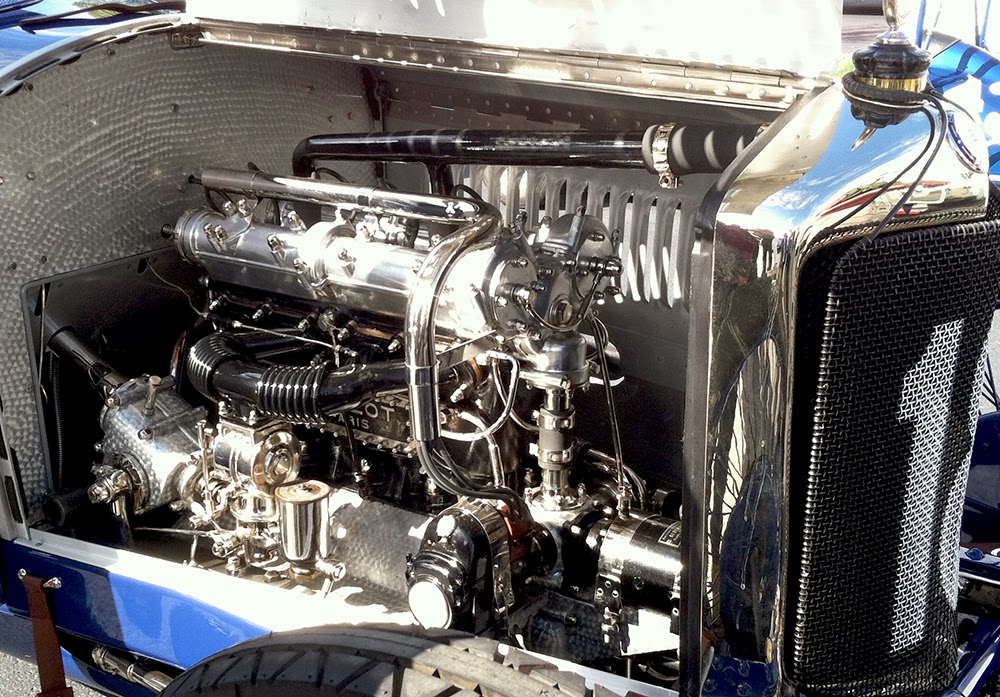
The DOHC 4-cylinder engine of the Ballot factory team car (photo in the collection of the author)

Thursday, October 17, 2013

Brass Cars at 2013 Hershey

Now back from the AACA's Eastern Fall Meet - better known as Hershey - and the event can be summed up in one word - wet. Regardless of all the rain, the sun did return on saturday, show day, and a good group of brass era cars took the field. The following are few cars that caught my eye. 


1907 Autocar Type XV (from the author's collection) 

1911 Locomobile Model M (from the author's collection) 

1912(?) Mercer Model 35 Raceabout (from the author's collection) 

Series 5 Mercer roadster (from the author's collection) 

Series 5 Mercer engine - L-head 4-cylinder (70hp) (from the author's collection) 

1905 Packard Model N (from the author's collection) 

Chris Paulsen's 1911 Page-Detroit in wonderful vintage patina (from the author's collection) 

1909 Peerless Model 19 - barn fresh (from the author's collection) 

1909 Peerless Model 19 - barn fresh (from the author's collection) 


Beautiful 1903 Stanley (I believe this to be chassis 845, ex-Earle Eckel) (from the author's collection)